Stefan Powell
Co-Founder & CEO, Dawn Aerospace


Stefan Powell is a New Zealand–Dutch aerospace engineer and the co-founder and chief executive of Dawn Aerospace, the space-transport company building reusable spaceplanes and non-toxic satellite propulsion across bases in Christchurch and the Netherlands.
Powell’s path ran through Delft. Drawn to sustainable engineering, he studied aerospace engineering at Delft University of Technology, where he joined the student rocketry club Delft Aerospace Rocket Engineering (DARE) — a group that set altitude records and, more gave him his founding conviction. After years of building rockets, he and his teammates concluded that the cost and effort of getting a single vehicle to the launchpad was simply not sustainable. The lesson that shaped everything since: the problem with space isn’t only propulsion, it’s that access is treated as a rare, expendable event rather than a repeatable operation. He went on to work in propulsion, including a period associated with Rocket Lab, before starting Dawn.
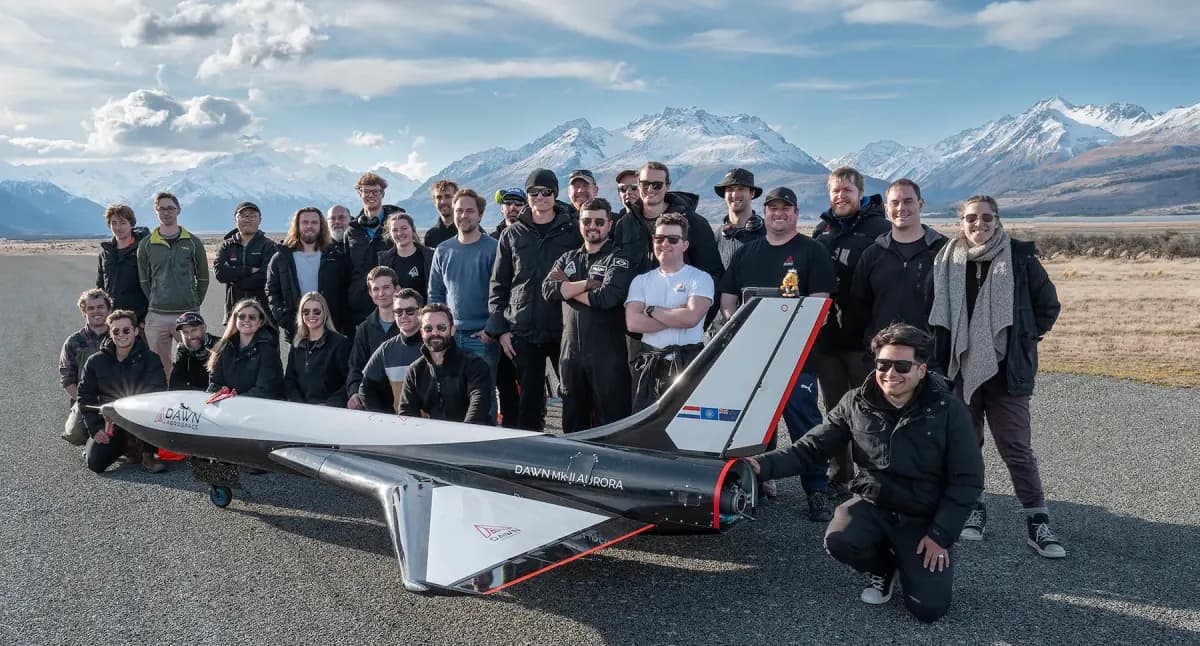
Founded in 2017, Dawn was built by Powell with his brother James Powell and three fellow engineers, Jeroen Wink, Robert Werner and Tobias Knop, split between New Zealand and the Netherlands. Rather than chase SpaceX down the vertical-rocket path, which Powell judged too capital-hungry, Dawn took a different bet: build space access that behaves like aviation. As CEO (and CTO) he has driven both halves of the company, a commercial satellite-propulsion business using non-toxic propellants and the Aurora, an uncrewed rocket-powered spaceplane designed to take off and land on a runway and fly repeatedly.
His framing is deliberately unglamorous. Dawn’s goal, as Powell describes it, is not to make space dramatic but to make it operational, to certify the Aurora as an aircraft rather than a rocket and ultimately to be the first vehicle to fly past the Kármán line, the 100 km boundary of space, twice in a single day. In 2024 the Mk-II Aurora flew supersonic, a milestone toward that aim.
Powell’s New Zealand connection is real and central: Dawn’s spaceplane flight-testing is anchored here, at sites including Glentanner Aerodrome near Aoraki/Mount Cook, drawing on the country’s unusually workable aviation-certification environment. In November 2025 he received the Prime Minister’s Space Prize for Professional Excellence, a $100,000 award recognising his contribution to New Zealand’s space sector.
Powell’s profile is noteworthy because he is one of the clearest New Zealand–linked deep-tech founders working at the global frontier of aerospace and because his core idea, that space should be repeatable rather than rare, is a different bet from the launch-spectacle model. His work is explored further in the Dawn Aerospace company story and the spaceplane explainer.
Sources: RNZ · The Next Web · Grokipedia
About this profile
This profile was researched and written by Noteworthy using publicly available sources. If something here is out of date or incorrect, let us know and we’ll review it.