Dawn Aerospace: The New Zealand–Linked Space Company Building Aircraft-Like Access to Space
Most space companies are judged by launches, the rocket, the countdown, the plume. Dawn Aerospace is trying to make that the wrong question. Its bet is.
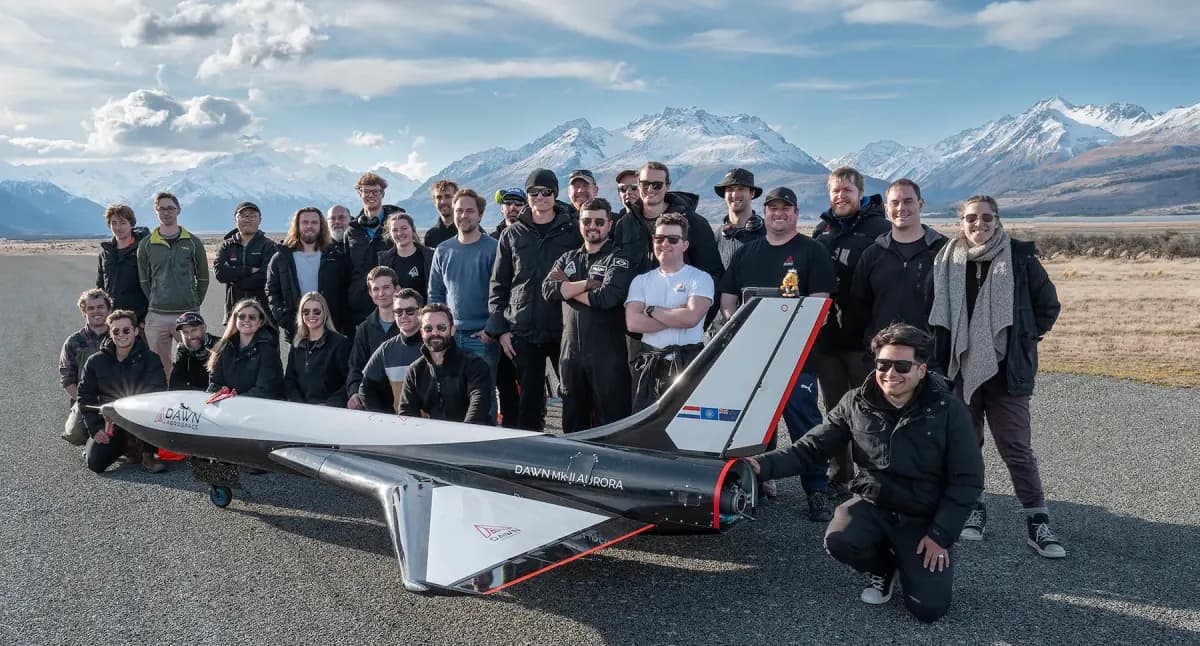
Most space companies are judged by launches, the rocket, the countdown, the plume. Dawn Aerospace is trying to make that the wrong question. Its bet is that space should be less like a rare launch event and more like a flight operation: repeatable, reliable and run more like aviation than artillery.
Dawn Aerospace is a space-transport company, founded in 2017, that builds two connected things: non-toxic propulsion systems that move satellites around in orbit and the Aurora, an uncrewed spaceplane designed to take off and land on a runway and fly to the edge of space repeatedly. It is dual-headquartered in Christchurch, New Zealand and Delft, the Netherlands, with further operations in France and the United States.
Where it comes from
Dawn’s roots are international. It was co-founded by Stefan Powell and his brother James Powell, New Zealand–Dutch dual citizens based in Christchurch, alongside Jeroen Wink (from the Netherlands) and Tobias Knop and Robert Werner (from Germany). The technical origins trace to Delft University of Technology, where Stefan and Knop were part of the student rocketry club DARE. The founders’ shared conclusion from those years was that the expensive, expendable, one-shot model of reaching space was holding the whole industry back.
It is worth being precise about the New Zealand connection, because it is real but not the whole story. Dawn Aerospace Limited is registered in Christchurch and the company has major New Zealand operations; its spaceplane flight-testing is anchored here and it draws heavily on New Zealand’s aircraft-certification system. But Dawn is also deeply Dutch, with significant Delft-based operations and is best described as New Zealand–linked and internationally built rather than a purely New Zealand company.
The propulsion business
It is easy to focus on the spaceplane and miss that Dawn already has a shipping, revenue-generating business: in-space propulsion. Satellites need to move, to reach their operating orbit, hold position, dodge debris and safely deorbit at end of life and Dawn makes the thrusters and propulsion systems that let them. Its systems use non-toxic, nitrous-oxide-based propellants rather than the traditional hydrazine, which is highly toxic and demands elaborate, costly handling. By the company’s own figures, it has more than 200 thrusters in space and over 30 customers internationally. Less toxic propellant means simpler ground handling and easier scaling, exactly the kind of operational friction Dawn is trying to remove.
The Aurora spaceplane
Dawn’s more attention-grabbing project is the Mk-II Aurora: a small, uncrewed, rocket-powered spaceplane built to operate like an aircraft. It takes off and lands horizontally from a runway and is designed to be turned around and flown again quickly rather than rebuilt or discarded. In 2024 it flew supersonic, reaching around 82,000 feet in tests conducted at sites including Glentanner Aerodrome near Aoraki/Mount Cook. The stated ambition is to become the first vehicle to fly past the Kármán line, the 100 km boundary widely taken to mark space, twice in a single day. That target has not yet been reached; the significance is in the operating model it is built around, explained in plain terms in what is a spaceplane?.
Why it matters for New Zealand
Dawn adds something specific to New Zealand’s space story: a deep-tech company whose centre of engineering and certification gravity sits substantially in Christchurch, beyond the country’s best-known space name. It demonstrates that New Zealand’s aviation regulatory capability, flight-testing conditions and engineering talent can support globally relevant aerospace work and that complex, exportable hardware can be built from a small country. It is one of the strongest examples of Christchurch’s growing role in New Zealand aerospace.
Why it matters more broadly
Dawn’s real proposition is operational, not theatrical. If propulsion can be made less toxic and easier to handle and if a spaceplane can be flown and reflown like an aircraft, then space stops being a sequence of expensive one-off events and starts becoming infrastructure. Dawn Aerospace is not trying to make space dramatic. It is trying to make it operational.
Explore the wider cluster: New Zealand aerospace stories