Built Here, Sold There: Inside New Zealand’s Game Studios
A New Zealander made one of the biggest games of the decade, walked away from it, and came home to build a studio in Dunedin. His story is the whole country’s games industry in miniature: build something the world wants, then decide whether to keep it or sell it.
In 2012 a University of Otago graduate named Dean Hall built a game about surviving a zombie apocalypse and accidentally made one of the biggest hits of the decade. DayZ sold millions of copies and spawned an entire genre of survival games. Hall could have ridden it for the rest of his career. Instead he handed it over, flew home, and set up a studio in Dunedin.
That decision, to make something the world wants and then choose what to do with it on your own terms, is the quiet story of an entire New Zealand industry. We are good at building game studios. We are less certain about what we want to happen to them next.
The Industry Nobody Mentions
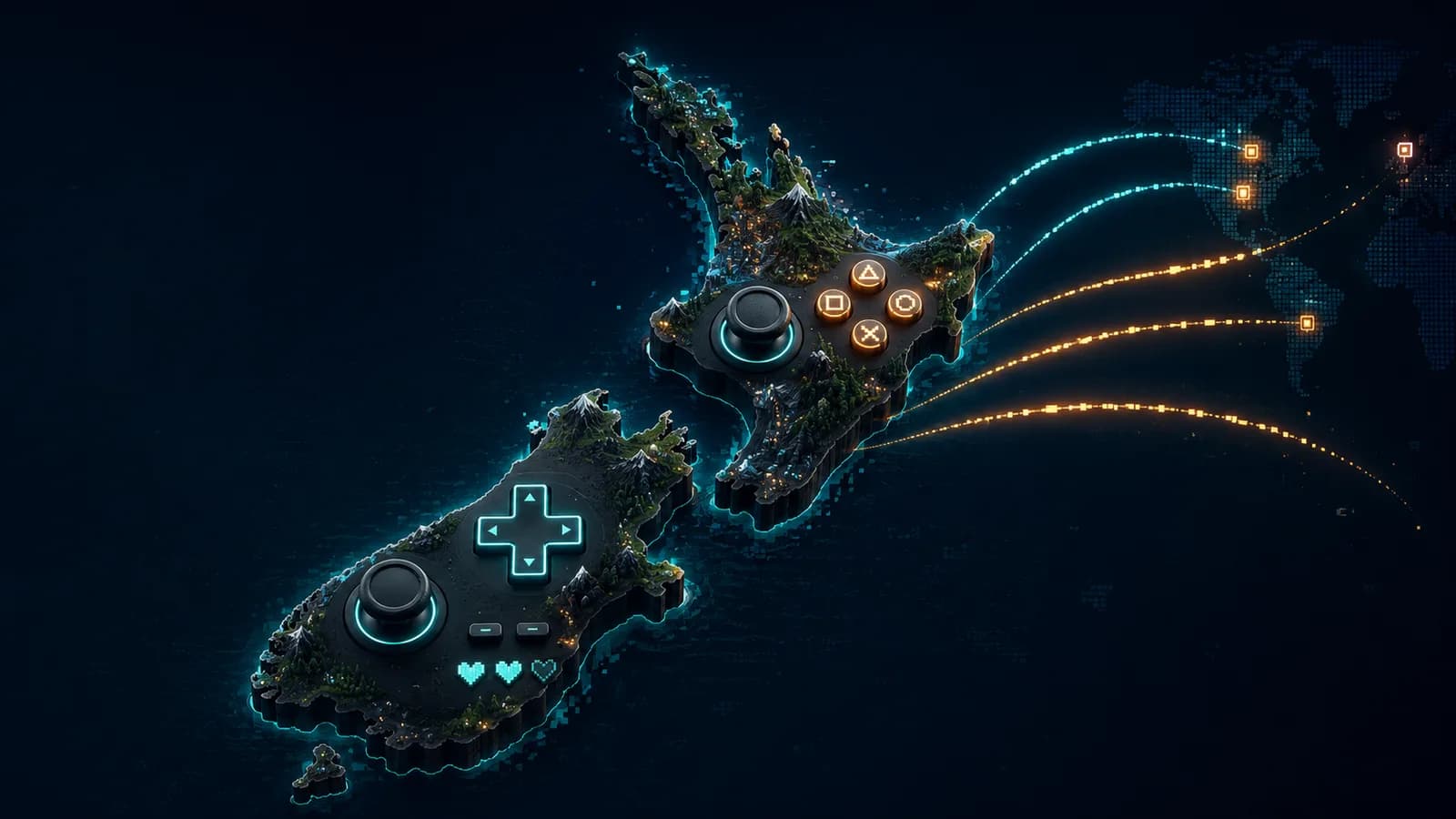
When New Zealanders talk about the country punching above its weight, the same names come up. Weta and the screen industry. Rocket Lab and the space companies. Agritech, fintech, a wool shoe that took on the world. Video games almost never make the list, and that is strange, because by the industry’s own count it is one of our fastest-growing digital exports.
The New Zealand Game Developers Association runs an annual survey of the sector. In its 2024 survey it put local studio revenue at $548 million, up from $434 million the year before, and reckoned the figure was heading past $750 million on the following year’s numbers. Almost none of it is earned here. Ninety-eight percent of the revenue from studios in the government’s rebate scheme comes from overseas. These are games made in Auckland, Wellington and Dunedin, sold to players in the United States, Europe and Asia who mostly have no idea where they came from. It is about as close to a pure export as a country gets, the kind of high-value, low-footprint earner we keep saying we want, growing at nearly forty percent in a single year, and it did all of that without anyone much noticing.
Part of the reason it stays invisible is the nature of the product. A game does not roll off a wharf or fill a shipping container. It ships as a download, from a laptop in Grey Lynn to a console in Ohio, leaving no trail through the ports or the headlines. The other reason is that the biggest local successes tend to disappear into larger foreign companies not long after they arrive.
The Studio That Beat the Giants
Start with the clearest example of how good the work is. Grinding Gear Games was founded in Auckland in 2006 by three friends who wanted to make the kind of deep, sprawling action role-playing game the big studios had stopped making. They had no publisher and very little money. They funded it themselves and built it slowly.
The game was Path of Exile, and it did something small studios are not supposed to do. It went head to head with Diablo, the genre-defining series from one of the largest publishers on earth, and it won a devoted global audience by being more generous and more complex than its giant rival. It was free to play, funded by players who chose to spend, and it became one of the most respected games of its kind anywhere. Here is the scale of it: Grinding Gear Games has reported revenue of around $526 million on its own. A single Auckland studio, earning nearly as much in a year as the industry body counted for the entire New Zealand sector.
In 2018 the Chinese technology giant Tencent bought a majority stake in Grinding Gear Games. The studio stayed in Auckland and kept its team, and the founders were open that the deal gave them the resources to keep building on their own terms. It is a good outcome by most measures. It is also the pattern: a New Zealand studio proves it can beat the best in the world, and then it belongs to someone offshore.
New Zealand is very good at building studios the world wants to own. It is still working out whether it wants to sell them.
Build, Then Sell
If Grinding Gear Games is the artistic high point, Ninja Kiwi is the cleanest business example. The Auckland studio built Bloons, a deceptively simple series of tower-defence games about monkeys popping balloons, into a franchise played by hundreds of millions of people. It was profitable, independent and quietly enormous.
In 2021 the Swedish media group MTG bought Ninja Kiwi in a deal reported at around two hundred million New Zealand dollars. Once again the studio stayed put and kept making its games. Once again the value it had built moved offshore. Two of the country’s standout studios, sold within a few years of each other, both still operating happily under foreign ownership.
There is nothing shameful in any of this. Selling to a larger partner can be the smartest move a small-country studio makes, and it is a decision New Zealand companies of every kind have had to make. It brings capital, distribution and the ability to survive the years when a game underperforms. Founders who spend a decade carrying all the risk have every right to take some of it off the table. But it is worth naming the pattern plainly, because it shapes what the industry becomes. New Zealand has been very good at the building. It has been much quieter about the keeping.
The One That Stayed
Not every studio follows the arc. PikPok, in Wellington, is the country’s oldest game studio, with roots going back to the 1990s under its earlier name Sidhe. It has stayed independent and New Zealand-owned through the entire rise of mobile gaming, releasing hit after hit on phones around the world while keeping its ownership at home.
PikPok is the proof that the sell-up ending is a choice and not a law of physics. Staying independent is harder and slower and riskier, and it means turning down the cheque that would make the founders wealthy overnight. It also means the studio, and the value it creates, stays a New Zealand business rather than a New Zealand branch office. Both paths are legitimate. The industry is still deciding which one it wants to be known for.
Why It Is Growing Now
The sector is not growing by accident. In 2023 the government introduced a twenty percent rebate for game developers, a direct response to Australian states that had been offering their own incentives and quietly poaching New Zealand studios across the Tasman. The rebate changed the maths. It made staying, and hiring, and expanding here more attractive than it had been, and studios that had been eyeing the door had a reason to stay.
There is also a talent pipeline the rest of the world would envy. The same country that trained a generation of artists, animators and technicians for the screen industry has a deep pool of exactly the people games studios need. Some of that talent flows straight from film into games, and the studios are spread across the country rather than bunched in one city: Auckland has the biggest cluster, Wellington carries the oldest names, and Dunedin has quietly become a games town of its own.
Which brings the story back to where it started. When Dean Hall walked away from DayZ, he did not sell a studio, because he did not yet have one. He built RocketWerkz from scratch, in Dunedin and later Auckland, and kept it. It is now one of the larger independent studios in the country, behind ambitious survival games like Icarus, hiring the kind of people who might once have gone into effects work. His whole career is an argument for the harder path: make the thing, then hold on to it.
The Question Under the Whole Thing
So here is the argument the industry has not quite had out loud. When a New Zealand studio sells to Tencent or MTG, is that a success or a failure of nerve?
One side says it is obviously a success. The studios stay open, the jobs stay here, the founders are rewarded for years of risk, and the country gets a reputation as a place that produces companies worth buying. A small nation cannot fund every ambition from its own pockets, and pretending otherwise just means fewer studios survive.
The other side says a country that only ever builds and sells never gets to own the thing it is best at. The profits, the intellectual property and the biggest decisions end up made somewhere else, adding to a long list of New Zealand success stories that quietly became foreign-owned. PikPok’s stubborn independence looks, from this angle, less like caution and more like the only version of the story where New Zealand keeps what it makes.
It is the same argument this country has about a lot of things it is good at. Sell the farm at a premium, or hold it and build something that lasts. There is no clean answer, and the honest truth is that the games industry has quietly chosen both, several times over, and come out the other side as a near half-billion-dollar export either way.
What is not in doubt is the talent. A New Zealander made one of the defining games of the 2010s and walked away to build something of his own back home. Three friends in Auckland beat the biggest name in their genre with no publisher and no money. A studio full of balloon-popping monkeys sold for more than two hundred million dollars. Whatever the industry decides to do with its winners next, it has stopped being a secret that it produces them.
Read more of our coverage of New Zealand technology and innovation.