Charleez Chicken & Chips: The National Brand With No Stores of Its Own
Drive through provincial New Zealand and you will pass the Charleez sign in a dairy, a superette, a service station, a café or a bakery. None of those shops belongs to Charleez. That is the whole idea.
Drive through provincial New Zealand and you will pass the Charleez sign in a dairy, a superette, a service station, a café or a bakery. None of those shops belongs to Charleez. That is the whole idea, and it has held together for nearly thirty years.
Most national food brands grow by opening stores or selling franchises. Charleez Chicken & Chips has done neither. Every outlet carrying the name is an independent business, owned by somebody local, that has chosen to put a Charleez cabinet in and trade under a shared brand. The company supplies the system, the ingredients and the training. The retailer supplies everything else, including the risk.
That structure makes the brand unusually dependent on the health of small-town retail, a sector that has spent three decades losing ground.
A Waikato Store, Then Four
Te Aroha is a town of a few thousand people at the foot of the Kaimai Range, the sort of place where the local convenience store is not one option among several. It is the option.
In 2015 the owner of Choice Convenience there, Sunny Judge, installed a Charleez cabinet. Eleven years on, he runs the system across all four of his Waikato stores.
“We introduced Charleez to our Te Aroha store in 2015, and the response from our customers was so positive that we now have Charleez in all four of our stores. The quality, consistency, and support have been excellent, and it’s become an important part of our business. We’d happily recommend Charleez to other independent retailers.”
Sunny Judge, Choice Convenience Stores, Waikato
It is a mild sentence carrying a firm commercial verdict. A retailer does not repeat a capital decision three more times unless the first one paid for itself. Four stores in the Waikato is also, in miniature, how the entire brand has been assembled: one owner at a time, deciding it works.
What the Corner Store Has Lost
The value of a hot food cabinet is easier to understand alongside what has been taken off the shelf around it.
Groceries went. Deregulated trading hours in the 1990s removed the dairy’s structural advantage, and the supermarket sector has spent the years since widening the price gap. A small store cannot buy at supermarket volumes, so it charges a premium for convenience. Retail NZ, which represents the sector, counted roughly four thousand dairies, superettes and convenience stores in its 2018 report on the future of the corner store, and found their sales had fallen almost a fifth in the preceding five years. The number of stores has kept falling since.
Cooked food is different, and the difference is structural. It is made on the premises and sold hot within the hour, so it cannot be shipped in from a distribution centre, ordered online or bought cheaper at a supermarket two towns away. On that one category, a store in a town of four thousand competes on level terms with anyone. It also changes the shape of the trading day, giving customers a reason to come in at a predictable time with a larger basket attached.
What Is Actually in the Cabinet
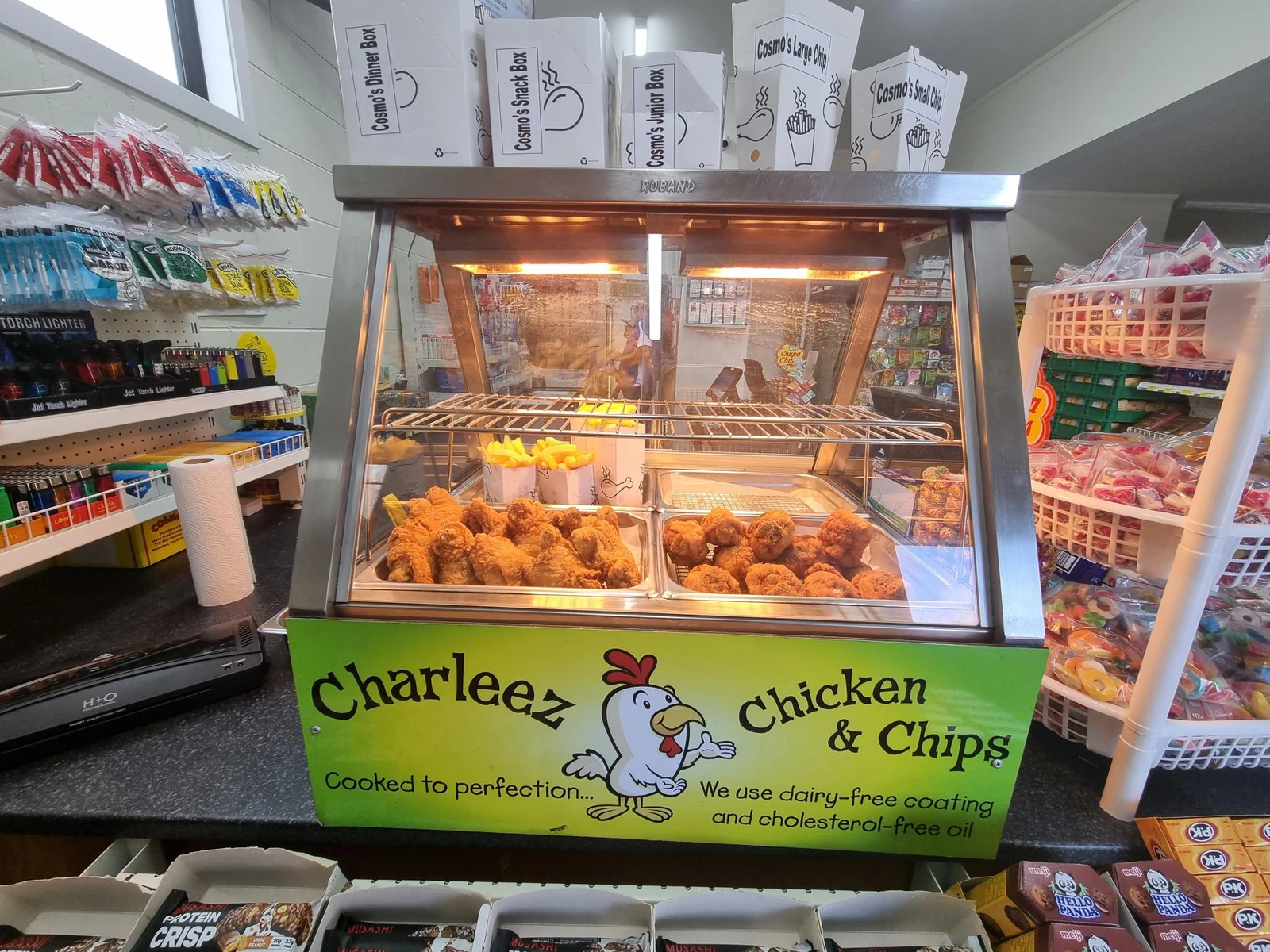
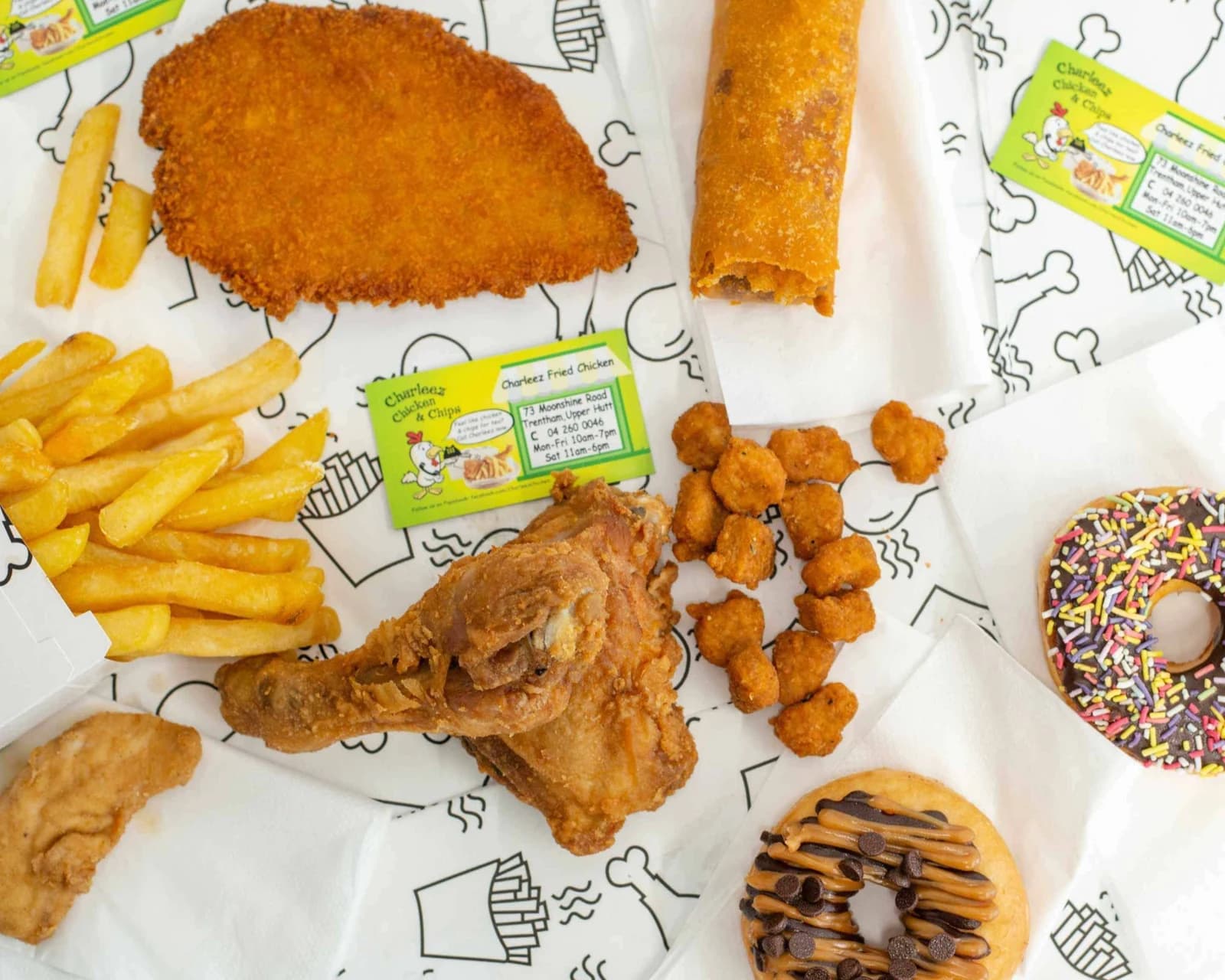
The offer itself is deliberately plain. Drums, thighs and tenders, chips in regular, large and jumbo serves, plus combinations of the two sized for one person or a family. Nothing on the menu asks a customer to think.
Behind it sits parent company Jayen’s own Cosmo’s range, developed and manufactured locally: seasonings, a range of dairy-free coatings, gluten-free instant mash and chicken gravy. The coating is the part that has to travel. A recipe that behaves the same in a Southland service station as it does in a Waikato superette, cooked by staff who joined last month, is the difference between a brand and a sign.
Because consistency is the hard part. Oil management, holding times, temperature records and staff turnover all sit between a good product and a bad one, and a customer only needs one bad one. That gap, rather than chicken itself, is the market Charleez sells into.
The System Behind the Brand
Jayen Food Concepts provides the system end to end: equipment specification and installation, the Cosmo’s ingredients, packaging, a menu and pricing structure, signage and hands-on training in the store. Because it supplies both the fryers and the food, the equipment and the ingredients come from the same place rather than from a supplier and a dealer who have never spoken.
Charleez sits alongside Top Taste Chicken ’N’ Chips, Cosmo’s and Crazy Mo’s under Jayen, with more than two hundred outlets nationally across the group and around ninety trading as Charleez.
South Island Sales Manager Andy Campbell describes Charleez as New Zealand’s only dedicated chicken training provider, combining in-store support with national brand recognition and locally manufactured coatings and seasonings.
For a retailer, the practical meaning is narrow and useful. Somebody shows the staff how to run the cabinet. Existing staff then bring new starters up to speed, and the trainer returns for a retrain when a store asks.
Why the Brand Does the Heavy Lifting
North Island Sales Manager Dave Gratwicke makes the case for branding more directly than most suppliers would.
“If it were easy, every independent store would be selling chicken and chips. It’s just not. Our branded stores outsell unbranded stores three to one. The difference is the brand.
Being self-employed is tough. There’s no one to lean on when you’re lost. The Charleez branding secret lies within the dedicated team behind you, the backup, support, and combined knowledge of the market and what works.”
Dave Gratwicke, North Island Sales Manager, Jayen Food Concepts
The logic is not really about the logo. A handwritten sign reading HOT CHICKEN tells a driver passing through at five o’clock nothing about what they are going to get. A recognised name does, and it borrows credibility that a single shop in a single town could not build alone.
Gratwicke’s second point matters as much. Running a small retail business in provincial New Zealand is an isolating job. There is no head office, no category manager, nobody to ring when sales fall and the reason is not obvious. Underneath the coating and the cabinet, what these systems offer is somebody to call.
A Family Business Since 1997
Jayen Food Concepts was formed in 1997 by John Neal and his partner Jan Turner. In 2016 John’s daughter Leanne Prujean and her husband Mark took the helm, and the company remains New Zealand owned and operated. It moved to new premises at Ngatea in June 2026. The company also lends its name to community causes, among them Kiwi Kids Charity, Go Baby Go NZ and The Great Kiwi Road Trip.
Nearly thirty years is a long run in a category with high churn on both sides of the counter, and a brand with no stores of its own has no way to ride out a bad year internally. If its retailers are not selling, neither is it.
Looking Ahead
The cabinet in the Morrinsville store looks much like the one in Te Aroha, and much like several hundred others around the country. Trays warmed from below, chips going out in branded Cosmo’s cartons, a queue that builds around half past four.
None of those shops has a head office. Between them, though, they have built something that behaves like a national brand, which in a sector that keeps losing categories to bigger competitors is not a small achievement. Sunny Judge worked that out in 2015. Charleez has been making the case to everyone else since 1997.
Retailers curious about a cabinet of their own can reach Jayen’s head office on 0800 622220, or through jayen.co.nz.